


What It Is | PRISMA Flow Diagram | Narrative Synthesis | Tables | Manuals & Guidance
What It Is
After you have collected your data, the next step is data synthesis. According to the Cochrane Handbook for Systematic Reviews of Interventions, “Synthesis is a process of bringing together data from a set of included studies with the aim of drawing conclusions about a body of evidence” (Cochrane).
You will present your evidence synthesis review results in various ways: narrative or descriptive syntheses and tables and/or figures for scoping and systematic reviews, and possibly a meta-analysis for systematic reviews.
Combining statistics from your included studies is a meta-analysis. A meta-analysis is possible if the included studies from your systematic review are homogenous (i.e., alike). See Chapter 10: Analysing data and undertaking meta-analyses in the Cochrane Handbook for more details. Similarly, if you are using qualitative data, you may do a meta-synthesis.
PRISMA Flow Diagram
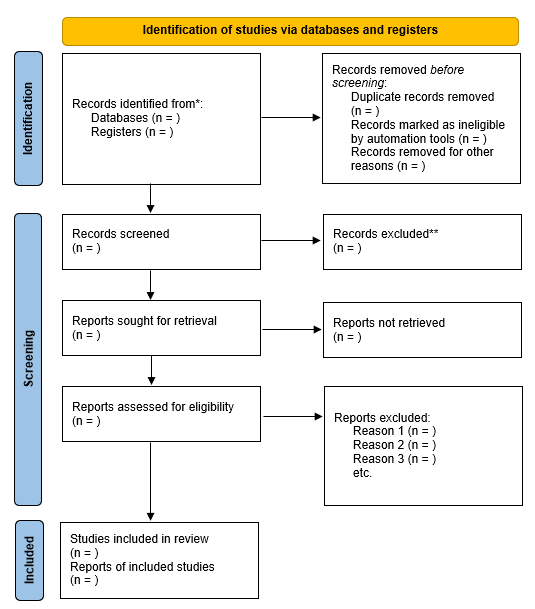
No matter the type of review conducted, a PRISMA Flow Diagram is required. Use the template provided by PRISMA and an appropriate extension for your evidence synthesis type.
If you worked with an NIH Librarian on your evidence synthesis, they can assist with creating the PRISMA Flow Diagram. If you have any questions on this step, contact the NIH Library.
Below is an example of an empty PRISMA Flow Diagram that each review team would complete. You can download the template in PDF or Microsoft Word format and should customize it with your review's results. Obtain the numbers to put into the boxes from the software used to screen and from the librarian that conducted the searches.
Narrative or Descriptive Synthesis
In a narrative synthesis:
- Text and tables summarize and explain your findings
- Describe study characteristics, context, and findings for each individual included study and all the included studies as a group
- Different thematic analysis approaches may be used for synthesizing the study findings for individual included studies and all the included studies as a group
For example, for individual included studies, provide details on participants, setting, exposure/intervention, outcomes, and other factors relevant to your research question (e.g., age, sex/gender, race or ethnicity of participants, length of exposure/intervention, sample size, etc.).
For describing as a group all your included studies, you might sub-group studies based on relevant criteria and summarize that sub-group’s key aspects.
Additionally, quantitative and qualitative data are synthesized differently regardless of the type of review conducted. For more information on synthesizing qualitative data, see articles by Higgins etal. 2019 and Noyes etal. 2019, and chapters from the Cochrane Handbook and JBI Manual for Evidence Synthesis for more information.
Tables
Here your data may be presented in a table format to summarize all your included studies (e.g., key characteristics table), and for a systematic review also include an evidence summary table. It is helpful to present key characteristics related to each included study (e.g., population, intervention/exposure, outcomes, setting, and other key features) in a table to help you and eventually your reader understand your results.
For examples of key characteristics or evidence summary tables, ask a NIH Librarian for additional help.
Manuals & Guidance
To learn more about synthesizing the data for your review, please refer to the resources listed below which contain much more detail and information on this important step. You can ask a NIH Librarian for additional help.
- McKenzie JE, Brennan SE, Ryan RE, Thomson HJ, Johnston RV. Chapter 9: Summarizing study characteristics and preparing for synthesis. In: Higgins JPT, Thomas J, Chandler J, Cumpston M, Li T, Page MJ, Welch VA (editors). Cochrane Handbook for Systematic Reviews of Interventions version 6.5 (updated August 2024). Cochrane, 2024.
- McKenzie JE, Brennan SE. Chapter 12: Synthesizing and presenting findings using other methods. In: Higgins JPT, Thomas J, Chandler J, Cumpston M, Li T, Page MJ, Welch VA (editors). Cochrane Handbook for Systematic Reviews of Interventions version 6.5 (updated August 2024). Cochrane, 2024.
- Deeks JJ, Higgins JPT, Altman DG (editors). Chapter 10: Analysing data and undertaking meta-analyses. In: Higgins JPT, Thomas J, Chandler J, Cumpston M, Li T, Page MJ, Welch VA (editors). Cochrane Handbook for Systematic Reviews of Interventions version 6.5 (updated August 2024). Cochrane, 2024.
- Pollock, D etal. Recommendations for the extraction, analysis, and presentation of results in scoping reviews. (2023). JBI Evidence Synthesis 21(3):p 520-532.
- Peters M, Marnie C, Tricco A, Pollock D, Munn Z, Alexander L, McInerney P, Godfrey C, Khalil H. Updated methodological guidance for the conduct of scoping reviews.(2020). JBI Evidence Synthesis 18(10):p 2119-2126.
- Moola S, Munn Z, Tufanaru C, Aromataris E, Sears K, Sfetcu R, Currie M, Lisy K, Qureshi R, Mattis P, Mu P. Chapter 7: Systematic reviews of etiology and risk - 7.3.6.5 Data synthesis. In: Aromataris E, Lockwood C, Porritt K, Pilla B, Jordan Z, (editors). JBI Manual for Evidence Synthesis. JBI; 2024.
- University of South Australia. Systematic Reviews: Data Synthesis.
- Hoffmann T C, Glasziou P P, Boutron I, Milne R, Perera R, Moher D et al. Better reporting of interventions: template for intervention description and replication (TIDieR) checklist and guide BMJ 2014; 348:g1687 doi: 10.1136/bmj.g1687
- Higgins JPT, López-López JA, Becker BJ, et al. Synthesising quantitative evidence in systematic reviews of complex health interventions. BMJ Global Health 2019;4:e000858.
- Noyes J, Booth A, Moore G, Flemming K, Tunçalp Ö, Shakibazadeh E. Synthesising quantitative and qualitative evidence to inform guidelines on complex interventions: clarifying the purposes, designs and outlining some methods. BMJ Glob Health. 2019 Jan 25;4(Suppl 1):e000893. doi: 10.1136/bmjgh-2018-000893. PMID: 30775016; PMCID: PMC6350750.
- Noyes J, Booth A, Cargo M, Flemming K, Harden A, Harris J, Garside R, Hannes K, Pantoja T, Thomas J. Chapter 21: Qualitative evidence. In: Higgins JPT, Thomas J, Chandler J, Cumpston M, Li T, Page MJ, Welch VA (editors). Cochrane Handbook for Systematic Reviews of Interventions version 6.5 (updated August 2024). Cochrane, 2024.
- Lockwood C, Porritt K, Munn Z, Rittenmeyer L, Salmond S, Bjerrum M, Loveday H, Carrier J, Stannard D. Chapter 3: Systematic reviews of qualitative evidence. In: Aromataris E, Lockwood C, Porritt K, Pilla B, Jordan Z, editors. JBI Manual for Evidence Synthesis. JBI; 2024.
Evidence Synthesis > Select, Collect & Synthesize
Eligibility Criteria | Screening | Using Covidence | Risk of Bias | Data Collection | Data Synthesis